The Warning Lights We Miss: TNFlyGirl and the Crash Chain
The Warning Lights We Miss: TNFlyGirl and the Crash Chain
Open the YouTube premiere and use this article as the companion source hub for the public records and clips discussed in the show.
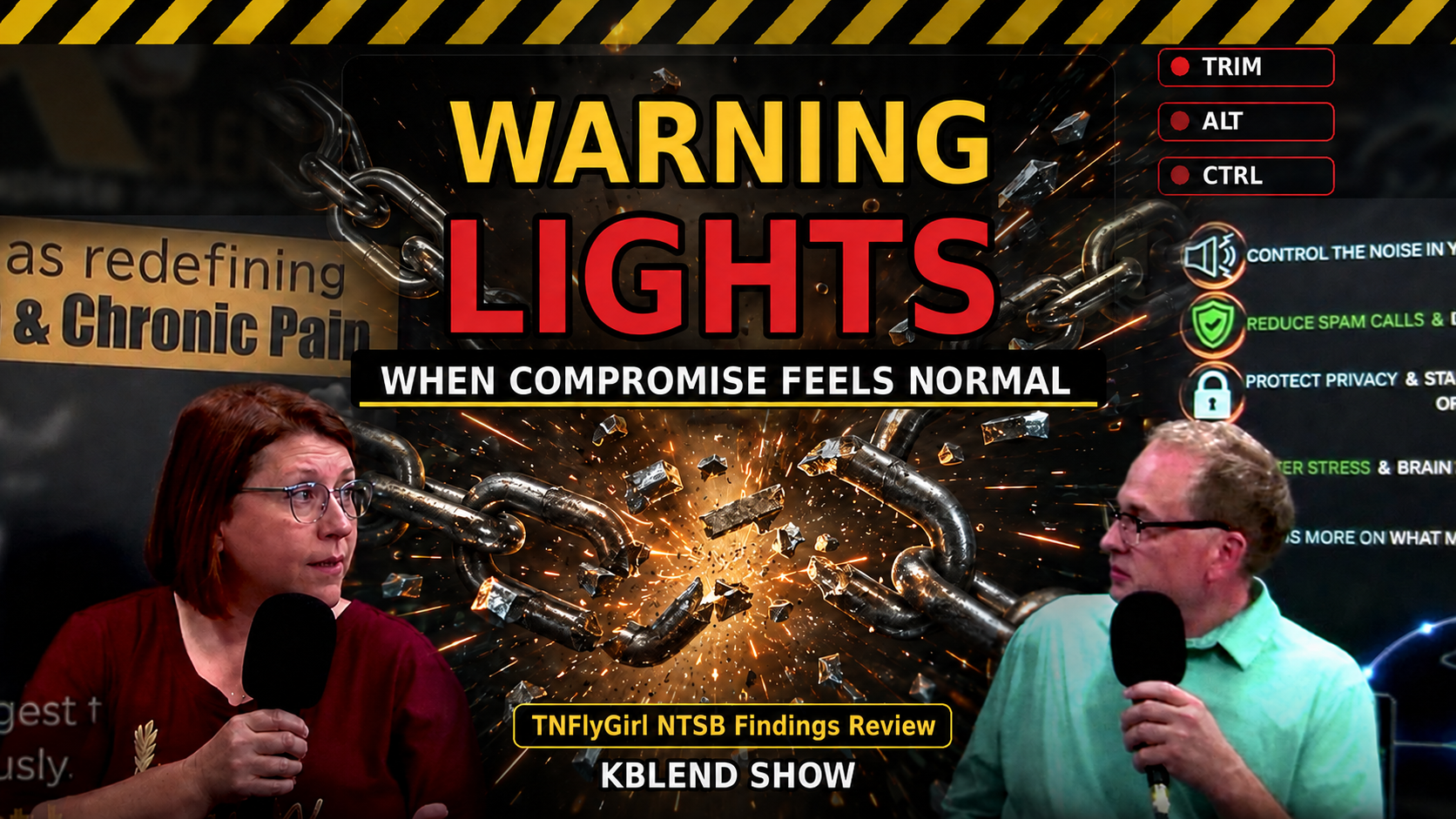
The Tennessee Fly Girl crash became one of those stories where the internet quickly found a label. The KBlend Show is taking a different path: aviation first, compassion intact, and focused on the warning lights people miss before tragedy.
John and Christa Klyder compare cockpit behavior to everyday patterns: getting behind the airplane, ignoring a warning cue, pressing ahead after a bad correction, and mistaking confidence for readiness. The point is not to sensationalize a crash. The point is to show how ordinary compromises can become an accident chain.
This is not an article written to blame a pilot who lost her life, or to sensationalize the death of her father. It is a public-safety conversation built from source materials, aviation experience, psychiatric experience, and compassion for every family that has ever looked back after a tragedy and wondered what signs were missed.
Our source material
The accident discussed in this KBlend Show episode is NTSB investigation ERA24FA058, involving Beech 35-C33 aircraft N5891J near Pulaski, Tennessee, on December 7, 2023. The National Transportation Safety Board public docket contains 20 released docket items and was publicly released on February 19, 2026.
KBlend is making the source packet available so listeners can see the materials behind the show. The NTSB final report states the probable cause as the pilot's failure to maintain airplane control after pilot-induced oscillations, resulting in impact with terrain. The report also discusses possible effects from medications found in toxicology, while noting that the available evidence was insufficient to determine whether medication effects contributed to the accident.
Source packet and references
- NTSB Final Report (external)
- NTSB Public Docket ERA24FA058 (external)
- NTSB Examination Report
- Performance Study
- ADSB Flight Track Profile
- ATC Summary of Flight
- Medical Factual Memorandum
- Toxicology Reports
- Flight Instructor Interview
- Flight Training Academy Manager Eyewitness Report
- Accident Site and Damage Photographs
- ATC Audio: ZME R60
Why KBlend is talking about this case
John Klyder brings the aviation lens. He has flown for decades and has worked as a flight instructor. In the show, he explains phrases that matter in small-aircraft safety: stick and rudder, getting behind the airplane, high-performance aircraft, complex systems, autopilot, trim, task saturation, and the difference between confidence and capability.
Christa Klyder brings the psychiatric and mental-health lens. The show looks at the toxicology discussion, anxiety and depression, and the larger medication culture that can leave people believing they are functioning normally while their judgment, reaction time, alertness, or emotional awareness may be altered.
That distinction matters. KBlend is not claiming that medication caused this crash. The NTSB did not establish that as a causal finding. What KBlend is doing is using the public record and the studio conversation to highlight a prevention question: are people being educated clearly enough about the activities they should avoid when taking medications that may affect alertness, cognition, dizziness, sedation, or motor skills?
Show highlights
These short clips preview the aviation safety thread in the episode and give viewers a direct path from the show into the source materials.
Stick And Rudder Before Gadgets
John explains the basic ability to fly the airplane before relying on avionics, electronics, and gadgets.
Behind The Airplane
The report discussion becomes a plain-language lesson on oscillations, late corrections, and getting behind the airplane.
Three Decisions Behind
A faster, more complex aircraft reduces the time available to notice, correct, and recover from a wrong decision.
The Trim Warning Light
The Century 2000 autopilot and trim cue make warning lights concrete: the aircraft was signaling, but the pilot had to know what to do with the signal.
Break The Accident Chain
The aviation accident-chain principle becomes the show bridge: identify the links early enough, and one broken link can change the outcome.
Never Bored In The Cockpit
A pilot-training rule with wider meaning: if you feel bored in the cockpit, you are probably missing something.
The aviation thread: getting behind the airplane
One of the strongest teaching moments in the show is John's explanation of getting behind the airplane. In aviation, that phrase describes the moment when the aircraft is moving faster than the pilot's planning, awareness, and decision-making. The airplane is still flying, but the pilot is now reacting late.
In a high-performance, complex aircraft, small delays matter. More speed means less time. More systems mean more chances to misunderstand what the airplane is telling you. If a pilot is already overwhelmed, sedated, anxious, dizzy, or cognitively slowed, the cockpit can become unforgiving very quickly.
The mental-health thread: functioning is not the same as being clear
A person can look successful, smile on camera, maintain an audience, and still be suffering privately. A person can also be prescribed medications and still not fully understand what those medications might mean for driving, flying, machinery, memory, dizziness, alertness, or reaction time.
That is why this conversation must be handled carefully. KBlend is not anti-medication. Some patients need medication. But people also deserve clear education, honest review, and a treatment path that does not reduce them to a list of symptoms or prescriptions.
The better question
The easy question is, "How could she make that mistake?"
The better question is, "How many systems failed to help her see the warning lights?"
A training system may see a student switching instructors. A family may see a loved one trying to prove competence. A prescriber may see anxiety and escalate medication. A regulator may rely on self-reporting. A public audience may see confidence and mistake it for safety.
When those systems do not speak clearly to each other, the person in the middle can be left alone with a risk they do not fully understand.
What we hope this episode does
We hope this conversation slows people down. We hope it helps pilots ask better questions before they fly. We hope it helps families talk about medication, anxiety, and performance pressure without shame. We hope it helps patients ask their providers direct questions about what they should avoid while taking a medication.
Most of all, we hope this episode honors the fact that tragedy should teach us without stripping dignity from the people who were lost.